works behind NAT
Self-hosted monitoring service
nodbeat
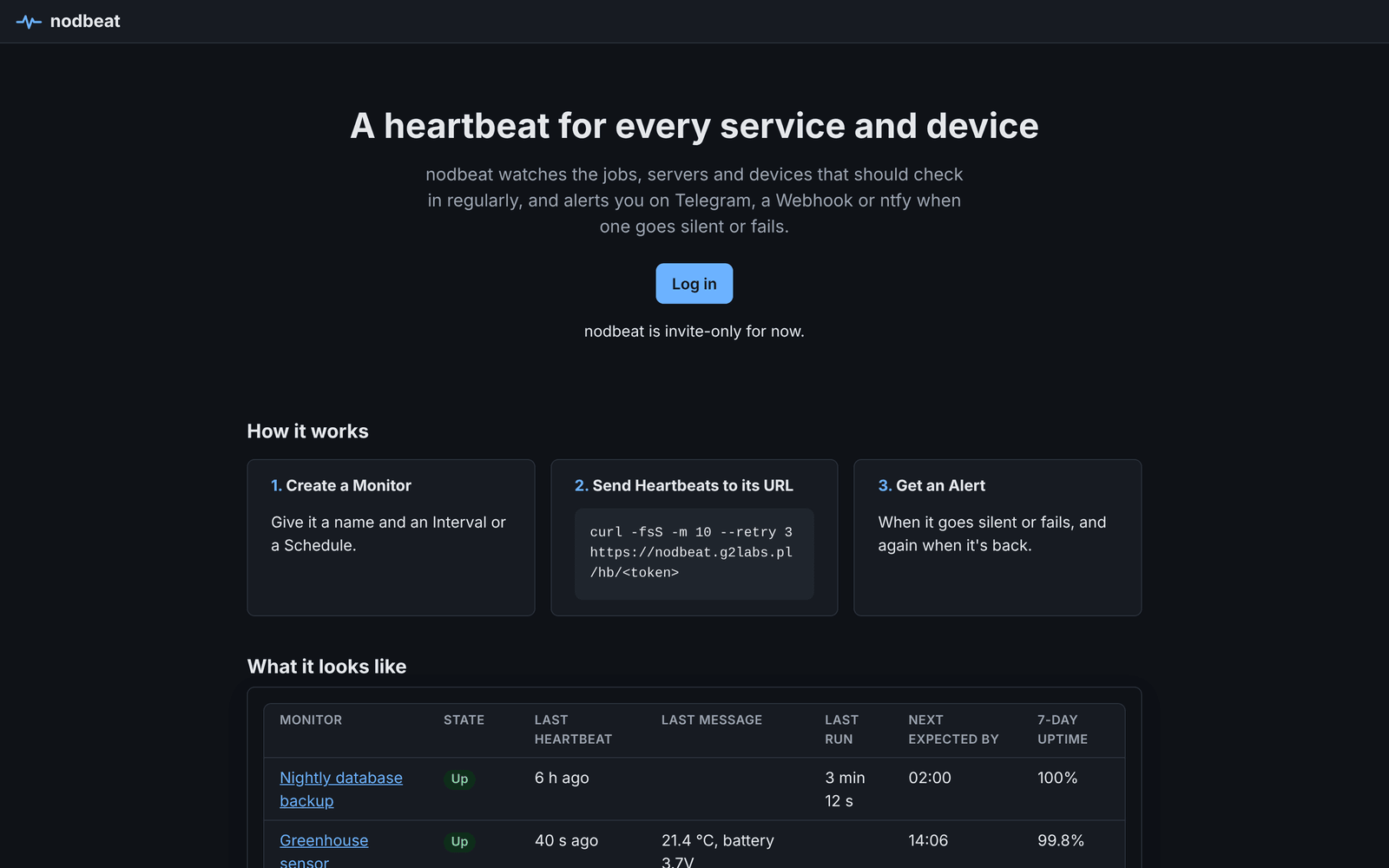
A heartbeat for every service and device. A small, self-hosted dead-man's switch: cron jobs, servers, Raspberry Pis, and ESP32 sensors ping a secret Heartbeat URL, and nodbeat alerts on Telegram, a Webhook, or ntfy when one goes silent or fails.
nodbeat came from the same problem on both sides of my work: backups, scripts, home servers, and battery-powered sensors that fail quietly. Heartbeats are push-only, so nodbeat never connects to what it watches and devices behind NAT work without any port forwarding. It runs live at nodbeat.g2labs.pl (invite-only for now), and the code is public under the MIT licence.
One line to integrate
curl -fsS -m 10 --retry 3 https://nodbeat.g2labs.pl/hb/<token>Product snapshot
Monitoring that works from behind NAT
interval or cron schedule
Telegram, Webhook, ntfy
open source
Who it is for
For anything that should check in and sometimes doesn't
- Developers and operators who need to know when a cron job, backup, or script stopped running
- IoT and embedded builders whose devices sit behind NAT and can only make outgoing HTTP requests
- Small teams and homelabs that want monitoring they can self-host instead of another SaaS account
How it works
Create a Monitor, send Heartbeats, get an Alert.
Each Monitor has a secret Heartbeat URL and an expected interval or schedule. When a Heartbeat is late, or a job reports a failure, nodbeat marks the Monitor Down and alerts you, then again when it is back.
TypeScriptFastifyMongoDBMonitoringIoTSelf-hostedOpen source
Product qualities
Small surface, real-world edge cases covered
Anything that can make an HTTP request
A cron job, a systemd timer, a Raspberry Pi, or an ESP32 with Wi-Fi: a GET or POST to the Heartbeat URL is all the integration it takes.
Interval or schedule
Expect a Heartbeat every few minutes, or at 02:00 on weekdays in a chosen time zone, with a grace period before a Monitor counts as Down.
Alerts that carry context
Down and recovery alerts include the last message a job sent, such as "battery 3.7V" or a failure reason, with reminders while a Monitor stays Down.
Features
Beyond "is it up?"
Feature
Start and Fail signals, so a failed run is Down at once and run time is measured
Feature
Max run time: a job that starts but hangs goes Down
Feature
Last message and change alerts, e.g. when "door=open" turns into "door=closed"
Feature
Reminders every 1, 6, or 24 hours while a Monitor stays Down
Feature
7-day uptime and incident history per Monitor, with paused time left out
Feature
JSON API and dashboard data for scripts and integrations
Why it matters for clients
The same engineering, applied to a whole product
Execution signal
A complete web product built and run end to end: backend, dashboard, alerting, API docs, Docker deployment, and a live instance
Execution signal
Designed around real device constraints: push-only heartbeats that work from behind NAT and from ESP32-class hardware
Execution signal
Developed in public with ADRs, a glossary, a changelog, and tests, the same discipline applied to client work